mind expanding
building a self-growing, personalized knowledge base

Imagine if you could perform research while you dream. You count sheep → You drift off to sleep → You dream → You awake → and then…there’s an updated overview of the latest and greatest research relevant to your interests ready to read.
And wouldn’t it be great if these overviews were organized by topic, in a format that resonates with you, and displayed as connections to other topics you care about? A personalized knowledge graph.
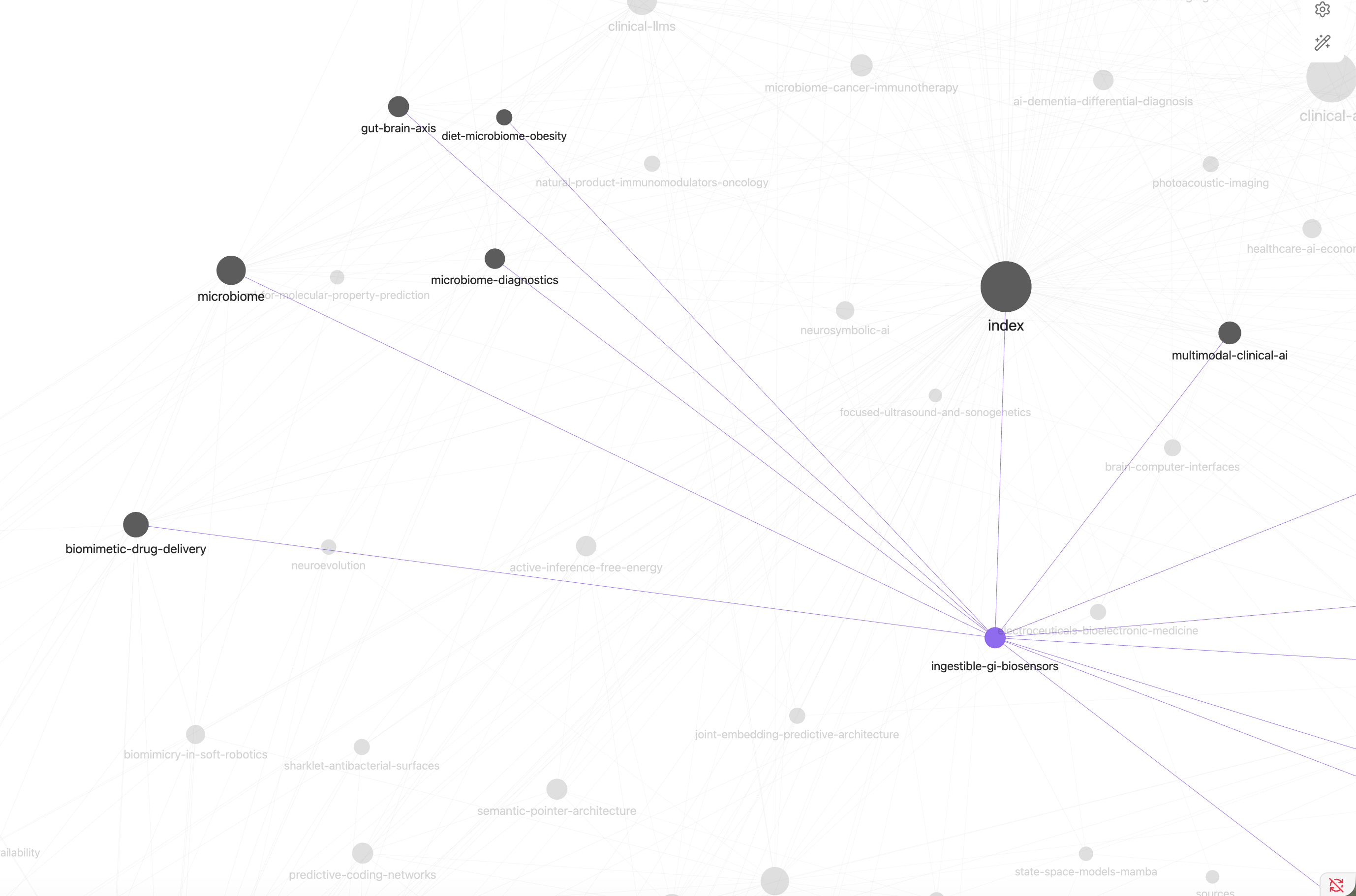
With inspiration by Andrej Karpathy’s post, help of Claude Code routines, and the elegance of the note-taking tool Obsidian, this setup is not just a dream. It can be your reality!
In the example screenshot above, you can see my setup created many personalized wikis, each represented by a unique node/circle in the graph. Relative connections between these wikis are also created, revealing which other ideas in the knowledge base are interconnected.
the flow
As I come across interesting articles and publications on the web, I use Obsidian’s Web Clipper tool to save content to my local Obsidian knowledge base. An additional optional yet extremely useful Python script will pull corresponding PDFs from abstract links (e.g. arXiv.org).
Every few days, a Claude agent in Anthropic’s cloud researches an under-developed topic in my private knowledge base, writes 3-5 new wikis synthesizing what I’ve already read, queues 30-60 URLs of further reading, fetches the actual content to embed properly in the syntheses, and pushes everything to a GitHub repo. Two hours later, a cron job on my Mac pulls down the repo to stay up to date. Then, I continue to add more clips as I browse. Repeat. All of this happens without touching a key.
mental model
Think of it as one organism with two halves:
- The brain (cloud, Claude routine) — identifies knowledge nodes that are not heavily connected, synthesizes information, searches for information.
- The hands (your laptop, Python & Claude Code) — collates saved clips from your browsing of the web
They talk through a shared Git repo. The brain fetches from the web, synthesizes, writes wikis, etc. The hands coordinate your manual browsing and clipping, synchronizing local knowledge base and the Github repo. Then the next brain cycle (i.e. Claude Code routine kickoff) has the new material to synthesize from.
next steps
Given the robustness of Claude Code today, next steps for you to recreate this are quite simple. Download Claude Code if you haven’t already. Copy and paste the link to this article and instruct it to walk you through setting this up for yourself. Create the Github repo, set up Claude Code routines in the cloud, establish a baseline CLAUDE.md with some of your interests, and enter the flow.
Then, whenever you are ready to peruse your graph, press Cmd+G in Obsidian to launch graph mode.
Happy learning!
ideas for further development
script to auto-clip any article or publication that is spent more than 2 minutes viewing
meta-reviews that are more broad than individual knowledge nodes
hypothesis and research idea engine, focusing on nodes that are not densely connected. These nodes likely correlate with a dearth of research on those topics.